
Practice Perfect

MESSAGE #1302 DOUBT YOUR DOUBTS

One of my favorite sayings is:

“Doubt your doubts.”

We all have a little negative voice inside our heads that shows up every once in a while (more often for some people).

Recently, I was coaching some tennis players and I introduced topspin to them. Before they even hit one ball, one of the players said, “Oh, I can’t do that.”

I was in shock.

This was a grown woman and she was counting herself out before she even started.

Fortunately, I was able to help her re-frame her negative voice and she actually performed quite well, but it could have been ugly. This type of limiting attitude is quite common, but we can choose to believe it, or doubt it.

Choose wisely.

Thanks for reading.

MESSAGE #1290 HOW TO PLAY YOUR BEST GAME

Let’s face it, most people play a reactionary game.

When they play well, they react positively.

When they play poorly, they react negatively.

The champions create how they play.

Here’s a great exercise to help you play your best game more often:

1. Think of a past great performance.
2. On an index card, write down what you did well during that performance.
3. Write down what you were focusing on.
4. Write down how you were feeling.
5. Write down what type of body language you had.
6. Keep that index card in your bag.
7. Read it before you practice or compete.
8. Then go out and duplicate that performance.

MESSAGE #1287 WHAT ARE YOU AIMING FOR?

A critical element of mental toughness is goal-setting. Many people think they have goals, but in actuality, they are merely wishes.

Most people know what they need to do, but most people do not DO what they know they need to do.

Here are a couple quick tips on setting goals:

1.   Write them down.
2.   Make them specific.
3.   Make them measurable.
4.   Make them attainable.
5.   Make them realistic.
6.   Make them timely (give yourself a deadline)
7.   Find an accountability partner (to keep you on track)
8.   Begin now.
9.   Persist.
10. Celebrate (then set a new goal)

The above is not a new formula, it has been around forever. The reason why, is because it works. And the reason why most people don’t achieve their goals is because they don’t stick with it. Taking action is the key.

I once went to the shooting range with a police sergeant friend of mine. He showed me how the gun worked, how to load/unload it, and he gave me tips on shooting techniques. We chose our type of target, i.e., a traditional target with a bullseye or a silhouette of a person holding a gun (a “bad guy”), which we could control the distances of.

My first shot was right in the bullseye! Beginners luck or good technique? I vote for good technique.

So what’s the point here? If I had just taken the gun and shot around, I would not know what I was doing, I would, most likely, not hit any targets, and someone could have gotten hurt.

Police officers go to the shooting range so that they can practice hitting targets. And practicing hitting targets will help them perform when it matters the most.

This applies to sports and life as well.

Write down your goals today!

MESSAGE #1283 THE ARROW CATCHER

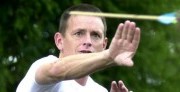
Anthony Kelly (above) likes to catch arrows with his bare hands. In fact, he also likes to catch paint balls. Kelly holds five Guinness World Records and supposedly has the fastest reactions on the planet. I caught up with Anthony recently and below is what I unearthed.

ET: What inspired you to do what you do?

AK: I was brought up watching Mohammed Ali and Bruce Lee and wanted to be like them (or better). I was amazed with their speed and power, also their strength of character.

ET: How do you train?

AK: I train and coach everyday both martial arts and Reaction Training from the beginners through to Olympic level athletes. This is important as our brains work in the same way but on different levels and I have found a way to open the channel between advanced and unexperienced athletes by the use of using basic learning skills and by building a strong foundation of learning to get the brain to reacting faster and faster as their training progress. Learning to react to stimuli, basically people on all levels enjoy learning and playing fast skills and are always happy to compete with others to gain extremely fast skills. One example I can give is play knuckles with me and you will quickly learn to respond faster. So to answer the question is I train by teaching and interacting with athletes on all levels of competencies.

ET: How do you cross-train?

AK: I am a coach of several sports and believe that training in many different sports is important, but the single most important aspect is to keep sharp by incorporating reaction action skills into every part of my life, like slipping through a door that’s about to shut, trying to catch things at ridicules speeds and enjoying the challenge of being as fast as I can be.

ET: How many other people do what you do?

AK: I hold many very unusual Guinness World Records and some have never been challenged, so that means that people are not interested or unwilling to achieve what I have. And as far as I know I am the only Specialist Reaction Coach. I introduced the World’s first electronic training device in 1995.

ET: What is your typical event like? Do you speak? Demo? Both?

AK: Training as I Coach is the best way for me to demonstrate the level that I work at and the level that athletes can achieve if they follow my Reaction training programme. Also once people are in the zone during training it is easier to communicate my ideas and philosophies about being super fast.

ET: Can reaction time be improved?

AK: Yes. Some people are born with ‘faster’ twitch fibre muscles then others, but I am a firm believer that you can improve any skill that you put your mind and body into learning. Through the correct training including:
A) Dedicate your life to being as fast as YOU can be. That means try and do the impossible like slipping into an automatic door before it closes play games with kids, but most importantly have fun.
B) Dream, visualize and create an awareness that you are the best that you can be and that you can even be better

ET: Do you work with athletes? How?

AK: I coach many local, state and national teams each year and individuals that what some training that is out of the ordinary.

ET: Were you “born” to do this?

AK: I have just been tested in some of the world’s best Universities and the conclusion is that I am 10 times faster than the average human and this is contributed to my genetics, (my father was very fast and strong and my grandfather was an famous bushman with extraordinary abilities, like grabbing a red-belly blacksnake and creaking (like a whip) their heads off and also my diet, which consists of just meat, potatoes, rice, bread and chocolate, I have NEVER eaten fruit or vegetables. Also my intense training resume.

ET: How has this helped you in other areas of life?

AK: Well I have a lot of fame but not much fortune. But training in martial arts and delving into the works of what goes on in our minds and body, it has shown me that we can all achieve what we want if we really want it.
My motto is ‘practice is the key to success’ so if I have a message it is find out what you want out of life and start training hard. Will you see results? Yes, but it will take time. Do not give up and you will achieve greatness.

For more on Anthony Kelly, visit: http://www.anthonykelly.com.au/
MESSAGE #1282 ARE YOU ON AUTOPILOT?

Many athletes and coaches focus on doing something until it’s automatic. Sometimes this is good, but sometimes this is bad.

I recently read about a study at McDonald’s restaurants. Researchers had many people in different locations go to a McDonald’s restaurant and ask for only an order of french fries. Not a very interesting study so far, but…

63 percent of the McDonald’s employees responded, “Do you want fries with that?”

Do you want fries with your fries?

The employees were conditioned to ask that question, even though it made no sense.

Sometimes automatic is bad.

What if you only practice under perfect conditions? What if you only practice against the same people?

You won’t be able to perform outside of your “vacuum.”

Be mindful when you practice.

When I train tennis players, I purposely hit them different types of shots, different types of spin and different types of speed. I even hit different types of tennis balls once in a while, that bounce differently, just to keep the players honest.

Training should be purposeful, not just so you “look good.”

Think about it.

MESSAGE #1277 MENTAL BLOCKS

We all get mental blocks. And we all need to overcome these blocks.

Imagine driving across the country from New York to California…with your emergency break on.

Many athletes go through their entire careers like that.

The problem is most people want to win, but they don’t want to get out of their comfort zone.

For all you athletes, amateur and professional, here’s my tip:

The best way to win more is to forget about winning.

During practice you need to THINK.

During competition you need to DO.

Play your game and trust your game.

MESSAGE #1262 A MESSAGE FROM MARK

The only pressure I’m under is the pressure I’ve put on myself.
-MARK MESSIER, hockey great

Recently, there was a football kicker training at my sports center. He is only 13 but has “phenom” written all over him. He has been working hard, doing all the right things and developing quite nicely.

This past week he was training for a pro event, which is a very big deal and only a few days away.

Then something happened.

He started missing kicks he was making easily the weeks prior. He started looking and feeling nervous. He was not the same person.

What changed?

Nothing physically, but mentally he started over-thinking. He was focusing on how important this upcoming pro event is. He started trying too hard. The little negative voice inside his head began getting louder and louder.

This happens all the time in sports and life.

When the pressure’s on, many people fold.

But it is not pressure, it is perception.

There are two ways to look at pressure–you can either get frustrated or fascinated by it.

The choice is yours.

What would be my advice to this young kicker?

1. Understand that nerves are normal. Everyone gets nervous.

2. Take a deep breath to lower your heart rate and stay in the present moment.

3. Focus on the target, not the outcome.

4. Act as if it were impossible to fail.

5. Cultivate gratitude and have fun!

For a free 10-minute mental toughness consultation, email: ed@edtseng.com or call 609.558.1077

The Book

Connect with Ed

Categories

Online Shop

Be The First One On Your Block To Have Tseng Performance Merchandise!

www.cafepress.com

Archives